


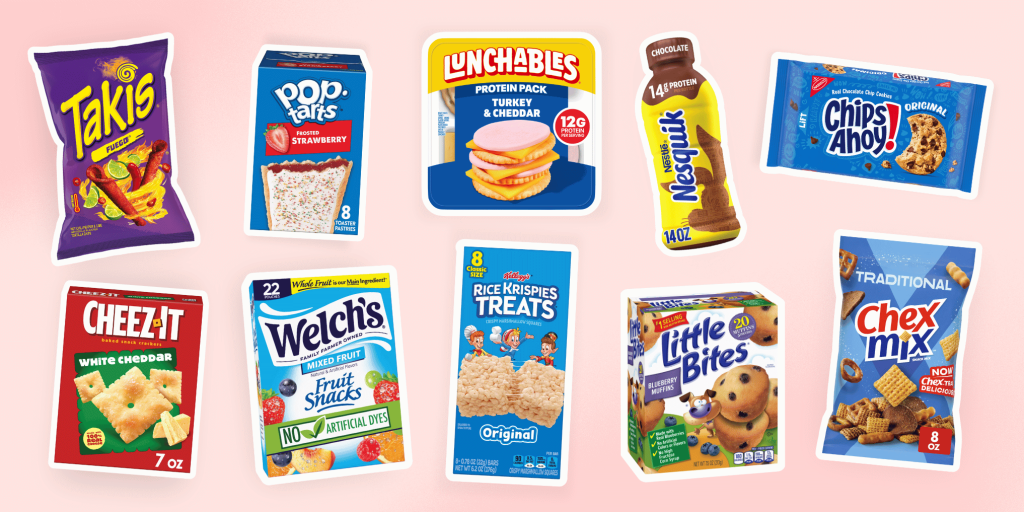
According to our study of the most widely consumed children’s snacks, 78% of snack products in the United States are ultra-processed. This isn’t just about candy and chips: it includes cheddar crackers, toaster pastries, and fruit snacks. Familiar staples of school lunchboxes across the country.
Parents reach for these snacks because they are portable, convenient, and loved by kids. But the fruit, cheese, milk, or protein pictured on the front can hide long lists of industrial ingredients, along with high levels of sugar or sodium. A snack that looks wholesome can therefore be a highly engineered ultra-processed product.
For this back-to-school investigation, we selected 10 popular children’s snacks that combine multiple markers of ultra-processing with high levels of sugar, sodium, or both. Product by product, we show what’s really behind these familiar lunchbox staples.
Ultra-processed foods: a growing concern for children’s health
Ultra-processed foods have quietly become the foundation of children’s diets in the United States. Behind their familiar packaging lies a category of products that science increasingly links to serious health risks.
What are ultra-processed foods?
The concept of ultra-processed foods was introduced in 2009 by Brazilian researcher Carlos Monteiro, who observed that traditional nutritional analysis, focused mainly on sugar, salt, fat, and calories, did not fully explain the rise of obesity and chronic diseases. What was changing was not just the amount of nutrients people consumed, but the nature of the foods themselves: meals prepared from simple ingredients were increasingly being replaced by standardized industrial products. This led to the NOVA classification, which divides foods into four groups, from unprocessed or minimally processed foods in group 1 to ultra-processed foods in group 41,2.
Processing food is not inherently a problem. Freezing vegetables, fermenting yogurt, or baking bread can preserve food and make it easier to consume without fundamentally changing what it is. Ultra-processing goes much further.
An ultra-processed food is not simply a prepared food, but an industrial formulation. Unlike a homemade dish, where whole ingredients are combined, it is built from fragments of other foods. Low-cost raw materials such as corn, wheat, or soy are first broken down into separate components, including powders, oils, and syrups. These components are then assembled with additives, such as emulsifiers, texturizing agents, colorants, and flavorings, to recreate the taste, texture, and appearance of food3.
In practice, ultra-processed foods can be identified through their ingredient list, following the approach proposed by the Food and Agriculture Organization of the United Nations (FAO) in 2019: namely by looking for the presence of industrial ingredients rarely found in a home kitchen (glucose syrup, maltodextrin, modified starches, protein isolates, hydrogenated oils) and/or “cosmetic” additives designed to modify taste, texture, color, or aroma (colorants, sweeteners, emulsifiers, flavor enhancers, flavorings). The result is a product designed to be convenient, highly appealing, and easy to consume4. One such ingredient is enough to place a product in this category, and that is the criterion we applied throughout this investigation.
Documented health risks
A growing body of research associates high consumption of ultra-processed foods with an increased risk of obesity, type 2 diabetes, cardiovascular disease, certain cancers, depressive symptoms, sleep disorders, and even premature death5,6. In large cohort studies, a 10% increase in the share of ultra-processed foods in the diet was associated with a 12% higher risk of overall cancer and a 15% higher risk of type 2 diabetes. These associations follow a dose-response pattern: the larger the share of ultra-processed foods in the diet, the higher the risk.
Several mechanisms may help explain these associations. In ultra-processed products the natural structure of food, known as the food matrix, is broken down. This can make nutrients more rapidly accessible, leading to faster blood sugar spikes. It also reduces the need to chew and creates foods that can be eaten very quickly, before the body has enough time to register fullness7,8.
Many ultra-processed foods are also deliberately engineered to be hyper-palatable. Manufacturers carefully adjust levels of sugar, sodium, and fat to reach the “bliss point,” the precise combination that maximizes pleasure. Combinations of high amounts of both sugar and fat, which are uncommon in whole foods but widespread in ultra-processed snacks, can produce an especially strong reward response and make these products difficult to stop eating9,10. An analysis combining more than 280 studies using the Yale Food Addiction Scale estimated that around 12% of children show signs consistent with food addiction, with ultra-processed foods playing a central role in these behaviors11.
👉Read Yuka’s full dossier on ultra-processed foods
Ultra-processed foods dominate children’s diets
For many children, ultra-processed foods are no longer occasional treats. In the United States and the United Kingdom, they account for more than 60% of the calories consumed by children and adolescents, placing both countries among the highest-consuming nations in the world12,13,14. The share is around 50% in France, Canada, and Australia, and substantially lower in countries such as Italy and Brazil, where it is just over 25%15.
Food marketing plays a central role in driving this consumption. A UNICEF survey conducted in 171 countries found that three in four children had seen advertising for soda, snacks, or fast food in the previous week, and that three in five young people said those ads made them want the products they had just seen. Young children, particularly before about age 7 or 8, do not yet fully understand the persuasive intent of advertising: they cannot distinguish commercials from cartoons. Adolescents also remain vulnerable to marketing, particularly on social media and other digital platforms, where behavioral tracking and algorithms allow highly personalized targeting. Food marketing can shape preferences and eating habits from childhood, sometimes for life, and foster brand loyalty during a formative period16.
Regular exposure to products with very sweet, salty, or fatty tastes, especially from an early age, can make intense flavors feel normal, gradually shaping the idea that food pleasure comes primarily from these products. Brightly colored packaging, mascots, and cartoon characters can further reinforce this attraction by creating an emotional attachment to products and brands before children are fully able to recognize their commercial purpose17,18.
At the same time, claims such as “rich in vitamins” or “no artificial flavors” can create a health halo, leading parents to perceive an ultra-processed product as healthier than it is19,20.
This pattern does not result from individual choices alone. Children grow up in a food environment where ultra-processed foods are omnipresent, heavily promoted, and often designed to appeal specifically to them.
The issue is not one cracker, fruit snack, or toaster pastry eaten occasionally, but a daily pattern in which ultra-processed products dominate a child’s diet during a critical period of development.
The 10 products called out by Yuka
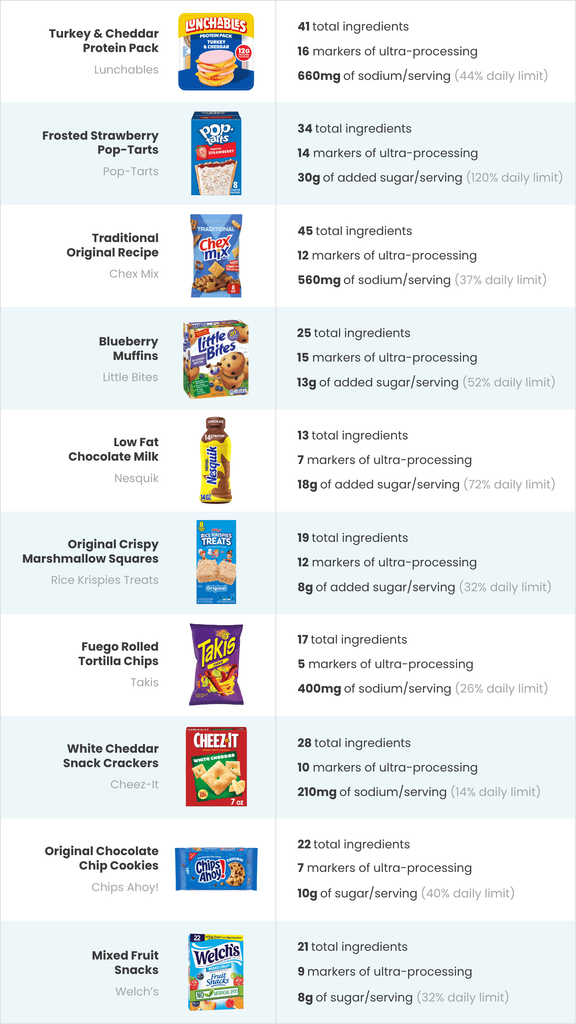
Behind the familiar packaging of these 10 lunchbox staples are long ingredient lists filled with markers of ultra-processing. Half of the selected snacks contain more than ten such markers. Six are also very high in sugar, and four are high in sodium, showing how much can be hidden inside products marketed as everyday choices for children.
Long ingredient lists packed with ultra-processed ingredients
The ingredient list is one of the clearest places to identify ultra-processing. Across the 10 snacks analyzed, the lists range from 13 to 45 ingredients, from Nesquik Low Fat Chocolate Milk to Traditional Chex Mix. Every product contains at least 5 markers of ultra-processing, and some contain as many as 16.
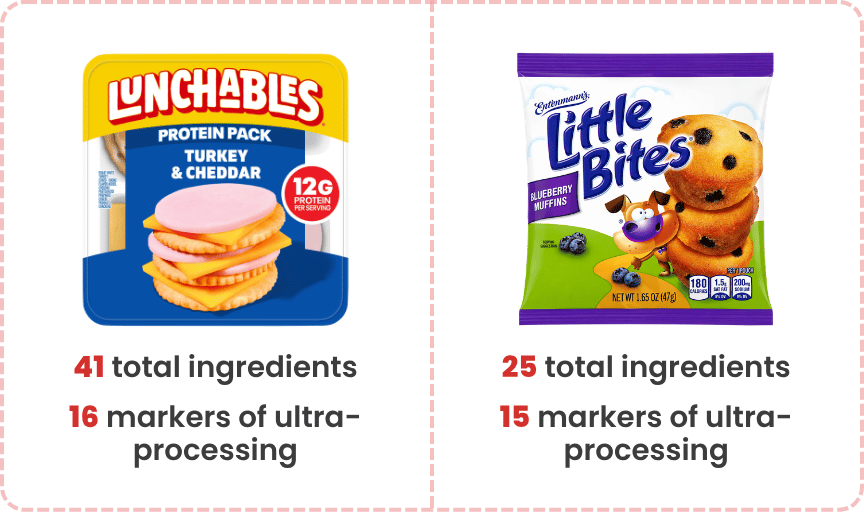
The Turkey & Cheddar Lunchables Protein Pack is one of the most striking examples. A tray of turkey, cheese, and crackers contains 41 ingredients, including 16 markers of ultra-processing, such as modified cornstarch, carrageenan, sodium phosphates, artificial flavor, smoke flavor, sodium nitrite, and lecithins. Little Bites Blueberry Muffins contain 25 ingredients, 15 of which are markers of ultra-processing, meaning these markers account for more than half of the ingredient list. They include modified starch, mono- and diglycerides, polysorbate 60 and several gums.
Among these markers, some are additives that Yuka considers high-risk. The most widespread is phosphate additives. Six of the 10 snacks selected contain them: Pop-Tarts, Chex Mix, Little Bites, Cheez-It, Lunchables, and Chips Ahoy. Phosphate additives can serve several functions, but in these products they are primarily used to modify or maintain texture. While phosphate additives are a source of phosphorus, an essential mineral, they can become problematic when consumed in excess. U.S. dietary data from 2015–2016 show that phosphorus intake already exceeds recommended levels, with Americans consuming approximately 1.5 to 3 times the recommended daily allowance21, depending on age group. Excessive phosphorus intake could interfere with bone mineralization, negatively affect kidney health, and increase cardiovascular risk22-25.
Another concern, particularly for children, is the presence of artificial colors: Pop-Tarts contain Red 40, Yellow 6, and Blue 1. These dyes are suspected of contributing to hyperactivity and attention-related disorders in some children26-29. In Europe, foods containing certain synthetic dyes must carry the warning: “May have an adverse effect on activity and attention in children.”30 While regulatory scrutiny of these dyes is increasing in the United States, Red 40, Yellow 6, and Blue 1 remain federally permitted as of August 2026. The FDA is, however, pursuing a voluntary, non-mandatory phaseout of synthetic dyes by the end of 2026, relying on manufacturers to remove them voluntarily, while several states have adopted stricter legal bans, including California’s ban in public schools starting in 202831,32.
Two of the products analyzed, Lunchables Turkey & Cheddar Protein Pack and Nesquik Low Fat Chocolate Milk, contain carrageenans, a cosmetic additive used for its thickening and gelling properties. Carrageenans have been linked to disruptions of the gut microbiota and intestinal inflammation. Persistent inflammation can weaken the intestinal barrier and may contribute to the development of chronic diseases, including type 2 diabetes, obesity, and certain cancers33-37.
While these are only a few examples, the selected products also contain several other additives of concern, including mono- and diglycerides, sodium nitrite, cellulose gum, monosodium glutamate, polysorbate 60, TBHQ, and BHT.
Too much sugar and sodium in a child-sized snack
Sugar is one of the clearest nutritional concerns across the snacks analyzed: a single serving of several products can account for a large share of a child’s recommended daily limit, and in some cases nearly all of it.
The American Academy of Pediatrics (AAP) recommends that children ages 2 and older consume less than 25 grams, or about 6 teaspoons, of added sugar per day38.
The U.S. context is particularly concerning. National dietary data from 2015–2016 found that children ages 6 to 11 consumed an average of 69.5 grams of added sugar per day, nearly three times the AAP recommendation39. High added-sugar intake during childhood is associated with obesity, tooth decay, hypertension, and other cardiovascular risk factors40.
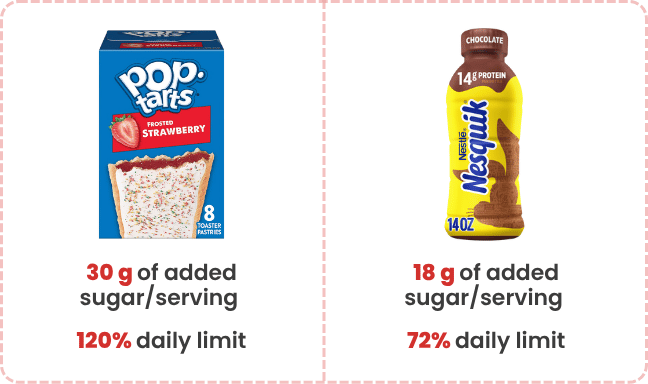
Several snacks in our analysis use up most or all of the recommended daily allowance in a single serving. A labeled serving of Frosted Strawberry Pop-Tarts contains 30 grams of added sugar, representing 120% of the AAP’s recommended daily maximum. A bottle of Nesquik Low Fat Chocolate Milk contains 18 grams of added sugar, representing 72% of the daily maximum.
Sodium is another major concern across several of the snacks analyzed, especially because children need less sodium than adults. The Centers for Disease Control and Prevention (CDC) recommends that children ages 4 to 8 consume less than 1,500 milligrams of sodium per day. It also notes that most sodium comes from processed foods and that highly processed foods high in sodium should be avoided41.
The U.S. context is concerning here too. According to the CDC, about 9 in 10 U.S. children ages 6 to 18 consume too much sodium, and a high-sodium diet can contribute to raised blood pressure during childhood. This matters because high blood pressure is a major risk factor for heart disease and stroke later in life42,43.
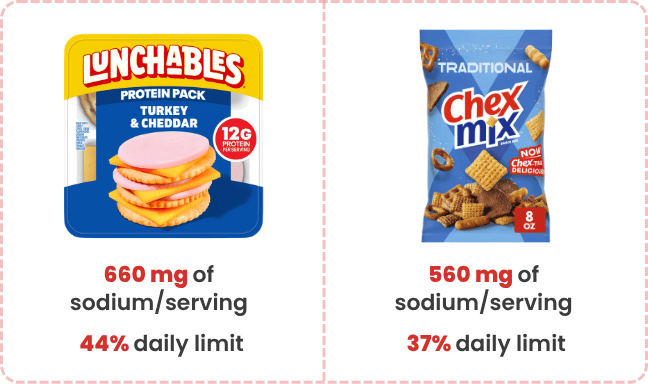
Several snacks in our analysis contain a substantial share of a young child’s daily sodium limit in just one serving. The Turkey & Cheddar Lunchables Protein Pack contains 660 milligrams of sodium, which represents 44% of the recommended daily limit for children ages 4 to 8. A serving of Traditional Chex Mix contains 560 milligrams, or 37% of that limit. Even a small 28-gram serving of Takis Fuego Rolled Tortilla Chips contains 400 milligrams, or 26% of the limit.
A single serving can therefore use up a substantial share of a child’s daily added-sugar or sodium allowance, and in some cases exceed the recommended limit entirely. Yet these everyday snacks can normalize overly sweet and salty foods from an early age, increasing children’s exposure to the health risks of excess sugar and sodium.
What the manufacturers say
Contacted by Yuka, Kraft was the only manufacturer to respond to our questions. The other brands included in this investigation did not reply to our requests.
Kraft said it is continuing to reformulate its Lunchables portfolio, with a focus on improving the quality and quantity of protein, adding fiber, and simplifying ingredient lists by removing artificial dyes and flavors. According to the company, several updated products are already available, with further changes planned for late summer 2027.
Regarding the Turkey & Cheddar Protein Pack, the company said that it has reduced the sodium content by more than 100 milligrams. Additional reformulation is underway to increase the product’s protein and fiber content, with an updated version expected to reach the market by the end of 2027.
Although the newer recipe contains less sodium and no artificial dyes, it still includes numerous markers of ultra-processing, such as modified cornstarch, dextrose, carrageenan, sodium phosphates, natural and artificial flavors, sodium nitrite, sorbic acid, and lecithins. Under the criteria used in this investigation, the product therefore remains ultra-processed.
Kraft’s response shows that reformulation is possible and that some improvements are already underway, even if there is still a long way to go.
What parents can do
Ultra-processed snacks are not a matter of individual choices alone, and no shopping habit can fix a food environment built to promote them. A few reflexes still make these products easier to spot.
- Read the ingredient list, not the front of the package. Claims such as “made with real fruit,” “good source of calcium,” or “no artificial flavors” say nothing about how a product was made. The ingredient list does, and its length is a first signal: a snack built from 30 or 40 ingredients is rarely a simply processed food.
- Use the kitchen test. Run through the ingredient list and count what you would never keep in your own kitchen: carrageenan, mono- and diglycerides, maltodextrin, phosphates, gums, artificial flavors, modified starch, etc. The more of them a snack stacks up, the further it sits from a recipe you could reproduce.
- Simple swaps hold up in a lunchbox. Plain crackers with a slice of cheese, plain yogurt with fresh fruit, popcorn, or a handful of nuts where school allergy rules allow, are just as easy to pack as a pouch or a tray, at a comparable cost.
👉 Read Yuka’s article on 10 Healthy Snack Ideas for Your Kids
Methodology
To carry out this investigation, Yuka reviewed snacks referenced in its U.S. database and selected 10 of the most-scanned products commonly consumed by children and frequently included in lunchboxes or eaten as after-school snacks. The selection intentionally focused on familiar products with long ingredient lists containing multiple markers of ultra-processing, as well as substantial amounts of sugar, sodium, or both. It is therefore a targeted selection designed to illustrate these characteristics.
For each product, Yuka analyzed the ingredient list and Nutrition Facts panel associated with the exact barcode and package format selected. The ingredient lists were reviewed by Yuka’s nutrition engineer, who identified non-culinary ingredients and cosmetic additives considered markers of ultra-processing, following the approach proposed by the Food and Agriculture Organization of the United Nations (FAO) for identifying ultra-processed products. Each distinct ingredient was counted once, including the individual components of compound ingredients when they were listed separately. Repeated ingredients were not counted more than once.
Sugar and sodium values correspond to the serving size defined by the manufacturer on the product label. When a package is labeled as a single serving, the values refer to the entire package. Because serving sizes vary between products, these figures show the amount consumed in one labeled serving.
For sugar, the percentage shown compares the amount of added sugar in one labeled serving with the AAP’s recommendation (25g added sugar/day). For sodium, the percentage shown compares the amount in one labeled serving with the CDC’s recommended limit (1,500 milligrams/day for children ages 4 to 8). These percentages are child-focused reference comparisons based on public health recommendations.
Separately, to estimate the prevalence of ultra-processing among children’s snacks in its database, Yuka assembled a sample of more than 200 of the most-scanned snack products in its U.S. database belonging to categories typically marketed to children or included in children’s lunchboxes (fruit snacks, crackers, cereal bars, cookies, chips, etc.). Their ingredient lists were extracted and reviewed by Yuka’s food and nutrition engineer. In line with the FAO approach, a product was classified as ultra-processed when its ingredient list contained at least one non-culinary ingredient or one cosmetic additive recognized as a marker of ultra-processing.
All product information was verified between July and August 2026. The findings therefore apply to the exact barcodes and package formats analyzed at the time of the investigation.

- ¹ Monteiro, C.A. “Nutrition and health. The issue is not food, nor nutrients, so much as processing.” Public Health Nutrition. 2009;12(5):729–731. doi:10.1017/S1368980009005291.
- ² Monteiro, C.A. et al. “NOVA. The star shines bright.” World Nutrition. 2016;7(1–3).
- ³ BeMiller, J.M. One Hundred Years of Commercial Food Carbohydrates in the United States. Whistler Center for Carbohydrate Research, Purdue University, 2009.
- ⁴ Food and Agriculture Organization of the United Nations. Ultra-Processed Foods, Diet Quality, and Health Using the NOVA Classification System. FAO; 2019.
- ⁵ Lane MM, Gamage E, Du S, et al. Ultra-processed food exposure and adverse health outcomes: umbrella review of epidemiological meta-analyses. BMJ. 2024;384:e077310. doi:10.1136/bmj-2023-077310.
- ⁶ Monteiro CA, Louzada ML, Steele-Martinez E, et al. Ultra-processed foods and human health: the main thesis and the evidence. The Lancet. 2025;406(10520):2667–2684. doi:10.1016/S0140-6736(25)01565-X.
- ⁷ Miller GD, Ragalie-Carr J, Torres-Gonzalez M. Perspective: Seeing the forest through the trees: the importance of food matrix in diet quality and human health. Advances in Nutrition. 2023;14(3):363–365. doi:10.1016/j.advnut.2023.03.005.
- ⁸ Weaver CM, Givens DI. Overview: the food matrix and its role in the diet. Critical Reviews in Food Science and Nutrition. 2025;65(30):6880–6897. doi:10.1080/10408398.2025.2453074.
- ⁹ van Tulleken C. Ultra-processed foods and public health: evidence of harm and of conflicts of interest in the food industry to evade regulation. Future Healthcare Journal. 2025;12(2):100263. doi:10.1016/j.fhj.2025.100263.
- ¹⁰ DiFeliceantonio AG, Coppin G, Rigoux L, et al. Supra-additive effects of combining fat and carbohydrate on food reward. Cell Metabolism. 2018;28(1):33–44.e3. doi:10.1016/j.cmet.2018.05.018.
- ¹¹ Praxedes, D.R.S. et al. “Prevalence of food addiction determined by the Yale Food Addiction Scale and associated factors: A systematic review with meta-analysis.” European Eating Disorders Review. 2022;30(2):85–95. doi:10.1002/erv.2878.
- ¹² Anne M. Williams, Ph.D., M.P.H., Catharine A. Couch, Ph.D., R.D., Samuel D. Emmerich, D.V.M., and Damon F. Ogburn, Ph.D., M.S.P.H., Ultra-processed Food Consumption in Youth and Adults: United States, August 2021–August 2023
- ¹³ Conway, R.E., Heuchan, G.N., Heggie, L. et al. Ultra-processed food intake in toddlerhood and mid-childhood in the UK: cross sectional and longitudinal perspectives. Eur J Nutr 63, 3149–3160 (2024). https://doi.org/10.1007/s00394-024-03496-7
- ¹⁴ Mertens E, Colizzi C, Peñalvo JL. Ultra-processed food consumption in adults across Europe. Eur J Nutr. 2022 Apr;61(3):1521-1539. doi: 10.1007/s00394-021-02733-7. Epub 2021 Dec 3. PMID: 34862518; PMCID: PMC8921104.
- ¹⁵ United Nations Children’s Fund. Feeding Profit: How Food Environments Are Failing Children. Child Nutrition Report 2025. UNICEF; 2025.
- ¹⁶ World Health Organization and UNICEF. Taking Action to Protect Children from the Harmful Impact of Food Marketing: A Child Rights-Based Approach. 2023.
- ¹⁷ Nesi J, Telzer EH, Prinstein MJ. Adolescent development in the digital media context. Psychological Inquiry. 2020;31(3):229–234. doi:10.1080/1047840X.2020.1820219.
- ¹⁸ European Union. Research Report: Manipulative Digital Marketing Practices Targeted at Children and Youth Online. 2024.
- ¹⁹ Mediano Stoltze F, Busey E, Taillie LS, Dillman Carpentier FR. Impact of warning labels on reducing health halo effects of nutrient content claims on breakfast cereal packages: a mixed-measures experiment. Appetite. 2021;163:105229. doi:10.1016/j.appet.2021.105229.
- ²⁰ Talati Z, Pettigrew S, Dixon H, Neal B, Ball K, Hughes C. Do health claims and front-of-pack labels lead to a positivity bias in unhealthy foods? Nutrients. 2016;8(12):787. doi:10.3390/nu8120787.
- ²¹ Fulgoni K, Fulgoni VL 3rd. Trends in Total, Added, and Natural Phosphorus Intake in Adult Americans, NHANES 1988-1994 to NHANES 2015-2016. Nutrients. 2021 Jun 29;13(7):2249. doi: 10.3390/nu13072249. PMID: 34210102; PMCID: PMC8308364.
- ²² Calvo MS, Dunford EK, Uribarri J (2023). Industrial Use of Phosphate Food Additives: A Mechanism Linking Ultra-Processed Food Intake to Cardiorenal Disease Risk? Nutrients. 2023 Aug 9;15(16):3510. doi: 10.3390/nu15163510. PMID: 37630701; PMCID: PMC10459924.
- ²³ Calvo MS, Tucker KL (2013). Is phosphorus intake that exceeds dietary requirements a risk factor in bone health? Ann N Y Acad Sci. 2013 Oct;1301:29-35.
- ²⁴ Calvo MS, Uribarri J (2013). Public health impact of dietary phosphorus excess on bone and cardiovascular health in the general population. Am J Clin Nutr. 2013 Jul;98(1):6-15. doi: 10.3945/ajcn.112.053934. Epub 2013 May 29.
- ²⁵ Ritz E et al., 2012. Phosphate additives in food--a health risk. Dtsch Arztebl Int 2012; 109(4): 49–55.
- ²⁶ OEHHA, 2021. Health Effects Assessment: Potential Neurobehavioral Effects of Synthetic Food Dyes in Children. California Environmental Protection Agency.
- ²⁷ Arnold et al. (2012). Artificial food colors and attention-deficit/hyperactivity symptoms: conclusions to dye for. Neurotherapeutics, 9(3), 599-609. https://www.ncbi.nlm.nih.gov/pmc/articles/PMC3441937/
- ²⁸ Nigg JT, Lewis K, Edinger T, Falk M. (2012). Meta-analysis of attention-deficit/hyperactivity disorder or ADHD symptoms, restriction diet, and synthetic food color additives. Journal of the American Academy of Child & Adolescent Psychiatry, 51(1), 86-97.e8.https://doi.org/10.1016/j.jaac.2011.10.015
- ²⁹ McCann et al. (2007). Food additives and hyperactive behaviour in 3-year-old and 8/9-year-old children in the community: a randomised, double-blinded, placebo-controlled trial. The Lancet, 370(9598), 1560-1567. https://www.ncbi.nlm.nih.gov/pubmed/17825405
- ³⁰ European Parliament and Council, Regulation (EC) No 1333/2008 of 16 December 2008 on food additives, Article 24 and Annex V.
- ³¹ FDA, 2025. HHS, FDA to Phase Out Petroleum-Based Synthetic Dyes from the Nation’s Food Supply. https://www.fda.gov/news-events/press-announcements/hhs-fda-phase-out-petroleum-based-synthetic-dyes-nations-food-supply
- ³² CAS, 2024. AB 2316: Pupil nutrition: substances: prohibition (Chapter 914). California Legislative Information.
- ³³ Kimilu N, Gładyś-Cieszyńska K, Pieszko M, Mańkowska-Wierzbicka D, Folwarski M (2024). Carrageenan in the Diet: Friend or Foe for Inflammatory Bowel Disease? Nutrients. 2024 Jun 6;16(11):1780. doi: 10.3390/nu16111780. PMID: 38892712; PMCID: PMC11174395. https://pubmed.ncbi.nlm.nih.gov/38892712/
- ³⁴ Naimi, S., Viennois, E., Gewirtz, A.T. et al (2021). Direct impact of commonly used dietary emulsifiers on human gut microbiota. Microbiome 9, 66 (2021). https://doi.org/10.1186/s40168-020-00996-6
- ³⁵ Prasedya ES, Miyake M, Kobayashi D, Hazama A (2016). Carrageenan delays cell cycle progression in human cancer cells in vitro demonstrated by FUCCI imaging. BMC Complement Altern Med. 2016 Aug 4;16:270. https://pubmed.ncbi.nlm.nih.gov/27487950/
- ³⁶ The Cornucopia Institute (2016). Carrageenan - New Studies Reinforce Link to Inflammation, Cancer and Diabetes. https://www.cornucopia.org/wp-content/uploads/2016/04/CarageenanReport-2016.pdf
- ³⁷ Bhattacharyya S, O-Sullivan I, Katyal S, Unterman T, Tobacman JK (2012). Exposure to the common food additive carrageenan leads to glucose intolerance, insulin resistance and inhibition of insulin signalling in HepG2 cells and C57BL/6J mice. Diabetologia. 2012 Jan;55(1):194-203.https://pubmed.ncbi.nlm.nih.gov/22011715/
- ³⁸ American Academy of Pediatrics. “Added sugar in kids’ diets: How much is too much?” AAP News. 2019.
- ³⁹ Bowman SA, Clemens JC, Friday JE, Schroeder N, LaComb RP. Added Sugars in American Children’s Diet: What We Eat in America, NHANES 2015–2016. Dietary Data Brief No. 26. U.S. Department of Agriculture, Agricultural Research Service; 2019.
- ⁴⁰ Vos MB, Kaar JL, Welsh JA, et al. Added sugars and cardiovascular disease risk in children: a scientific statement from the American Heart Association. Circulation. 2017;135(19)–e1034. doi:10.1161/CIR.0000000000000439.
- ⁴¹ Centers for Disease Control and Prevention. “Nutrition Facts Label and Your Health.” Updated April 14, 2026
- ⁴² Centers for Disease Control and Prevention. “Vital Signs: Reducing Sodium in Children’s Diets.”
- ⁴³ Centers for Disease Control and Prevention. “About Sodium and Health.” Updated 2026.

My friend is allergic to red 40 but the other day I saw he chewing blue gum and eating a blue airhead that has red 40 in it.
Thanks so much for this informative article! Appreciate the details and will help me when purchasing or making up the snacks and lunches for my son.
How bad is Marree noodles
Thank you so much for your information and advice.
How about some suggestions of something my kids will eat?
Keep up the great work on this
I am glad to thank you for the YUKA. That’s a great job.
Great info and so important. We are inundated with so many processeds foods that your app is a necessity when I shop. Thank you for this research; love the Yuka app!
WOW, great work.
This is rly helpful, but the food is so good! I’m not an adult btw. Hopefully I start eating healthier and only eat these a few times like a month or smth
How can I share this information on my TikTok page?
I work in school with children. The breakfast they have fir free irs the worst garbage I’ve ever seen. All bioengineer and sugar and textureing agents in all. The kids can’t learn they all depressed and hyper
Can we get some alternatives that replace these? I am a 12-year-old, but I also agree with you that these “foods” are not edible.
Thank you!!!
Excellent data, need to eat healthier.Thanks for the hard work !
I love hearing about this. I my field of sports medicine debates can get heated amongst other professionals, including registered dieticians, who don’t believe in limiting ultra-processed foods or increasing intake -of whole organic foods, claiming it does little to effect health. This is why Yuka goes above and beyond to be a great source for people to use.
I would love to see Yuka expand into more of the supplement industry because it is so unregulated and companies often falsify “third-party testing.” Showing my athletes this app so they can simply scan a supplement we recommend to see if it has any banned substances or unhealthy chemicals would be a huge W for the roster.
Part of the problem has to do with properly educating our children about food and food quality. The manufacturers aren’t the whole problem, I’m sure that a huge portion of the population in the United States isn’t truly aware of our food issues and don’t understand how various additives affect people, especially over lifetimes. I applaud and appreciate what Yuka is doing in this regard.
The alternate snacks are great if you can provide them at home. I’m involved in several organizations that pack lunches/dinners/weekend food for economically challenged families. Are there any packaged snacks that you could recommend? We often pre-pack a week ahead of time for delivery purposes. I do use the app and love the alternatives that you provide so that does help but could use more ideas. Thank you.
Suggestions please for healthy snacks that kids will eat.
When I see another shopper looking at the back of a product, I step up and offer to scan it for them. As I do this, I explain what the Yuka App is all about while also pointing out the information on my screen. I have had no complaints, many thanks, and several have added the Yuka App from just this one interaction, or maybe it’s an intervention. 😉
Thank you ! Please post the good choices in snacks for adults and children
Thank you for the education. We are grateful 🙏 Yuka has been useful to my family but we need alternatives for this kids snacks you call out.
Thank you for your ongoing work and endeavors and keeping us informed!
Thanks for your research & information to support our food choices & provide recommendations. I use the app daily & am shocked by what I put right back oh shelf, & the marketing of some old “trusted “ brands. It’s hard because I work in a grocery store.
The ignorance of the ultra processed food manufacturers producing the snacks and quick grab feeders only guarantees raising obesity levels among kids. Thus, taking health focus of parents to a lower range.
The ignorance of the ultra processed food manufacturers producing the snacks and quick grab feeders only guarantees raising obesity levels among kids. Thus, taking health focus of parents to a lower range.
I do so appreciate what you are doing for our children, but I really wish you could also give alternatives to the unhealthy quick foods you called out. So many parents want to do right by their kids but, due to having full-time jobs, limited income and crazy schedules, they just can’t fit everything in. Just an idea…. surely in your investigations, you’ve found something feasible??
Thank you so much YUKA!! I’m new to the app but love discovering better options for my great nieces & myself. I also share the app with anyone that asks ( including clerks in the stores I frequent)!
Thank you Yuka! I spread your App to anyone that will listen to me. It’s a life changer.
Thank you so much for all this in depth information. It is very helpful in educating people and helping them to make better choices
Fabulous investigation into these common snack foods which will never again be in my grocery cart.
We need some qualified people in the USDA, HHS who know what they are doing. No political appointees who believe in conspiracy theory. MAHA is a joke! Thank you Julia and Yuka for giving us the info we need to make sure that our children, grandchildren and ourselves are getting excellent nutrition advice.
RFK Jr. is trying so hard to make this country healthier. I hope he is able to continue.
Thank you for keeping us informed and aware. I use your app every time I go to the grocery store. Bless you for all your efforts 👍🏻👍🏻
Yuka is Phenomenal !!
Thank you for standing against up the children and adults to keep us health! Keep up the good work. I used Yuka for everything. It’s a great resource
Thank you for standing against up the children and adults to keep us health!
Good work!!
Its a start
Our current government does not care
Other countries do care about its population and are really trying
Thank you so much for all this in depth information. It is very helpful in educating people and helping them to make better choices
I love ❤️ Yuka
all off trash
I love the 10 worst kids snacks. However, it would be great to see a solution, how about the 10 healthiest kid snacks?
Wow great work, thank you for the update!
Hello,
Thank you for everything you and Yuka are doing for humanity. It is amazing work and is giving much needed attention to what this corporate consumeristic world is willing to overlook for greed.
It’s not surprising to see some of these comments loaded with ignorance, laziness, blame and overall arrogance.
The article presents us, the consumer, with a load of helpful, caring, researched and proven information.
Perhaps take what she/Yuka has painstakingly, through hard work, desire and true compassion, put together and use it as a stepping stone to further your decision making and combine it with your own responsibility to take your health seriously.
Some very simple answers to some of the comments injected would be to read the entire article. Another is to think whole foods, grown/raised naturally (very well known fact that I guess obviously needs to be repeated over n over). Maybe not the ultimate option but sure is better than processed/ultra processed…Here’s a simple example: An apple vs applesauce that’s been processed and ingredients added. Maybe organic for an even better option. Do some research and engage your brain, get out of your lazy blame everyone else recliner wanting the easy handed to you route and do something yourself.
Be thankful for her/Yuka’s hard work and that she decided to share it with the world, on top of putting together an awesome app for our ease of use…
Thank you
Keep up the good work investigating all these proceed , dangerous foods , with harmful effects on kids and adults! It’s our responsibility as a parent to protect our children who cannot make their own decisions especially at a young age! Tk you for info!!
Thank you Yuka for raising awareness in this! Glad to see action in the manufactuer, although small, and only one, but it’s a step forward. I’m sure with more cosumer awareness, things are GOING TO change. Thank you!
I guess Yuka should have mentioned the healthy alternatives more prominently: “Plain crackers with a slice of cheese, plain yogurt with fresh fruit, popcorn, or a handful of nuts where school allergy rules allow”. That’s really it! We use crackers or pretzels, cheese slices, boiled eggs, slices of apples, grapes, strawberries and sometimes walnuts or whichever nuts kids like. Sometimes we add Clif energy bars (peanut butter or chocolate chip), they get 54/100 score because of sugar and calories but at least don’t come with risky additives.
I’m so happy to read about this investigation, this app has been in my life for the last few years and has changed the way me and my family live for the better. It came at a time when I had health issues and now my health has improved and YUKA is a big reason why! Please keep on doing what you’re doing and if you have any career openings, I have a degree in marketing and advertising. I would love to be an employee and help spread your message nationwide and even worldwide.! Thank you so much 😊
Can you recommend some snack products for children that are healthy options?
Carrot sticks, zucchini slices, etc. Also, nuts and seeds, dried fruits. Homemade granola bars and even cookies because you know what is going in them.
The United States is so far behind on this.
Carrageen should be outlawed like it is overseas.
Its all about the mighty dollar.
How about 10 alternatives for these food that are at common grocery stores not over priced whole paycheck food markets!
Thank you for this valuable awareness that needs to be utilized by the public, the consumers and Not just reliance on “THIS NEW ADMINISTRATION “. Yuka provides the information for me to make better food choices and to spread those options. I introduce Yuka to others almost every time I shop a grocery store and have Never had a negative response. Most people load the app on the spot.
Thanks for all your great work and partnership with CR.
I will continue to share the education of Choices.
HOPE THIS NEW ADMINISRTATION WILL GET THE ADDITIVES, PESTISIDES OUT OF THE FOOD ASAP. THANK YOU FOR YOUR MISSION YUKA!!!
AS A FORMER EDUCATOR OF NUTRITION/ FOOD SCIENCE AT A N.J. UNIVERSITY AND MY LOCAL HIGH SCHOOL IN NEW JERSEY I HOPE FOR MORE PEOPLE TO GET INVOLVED!!!
There is so much processed foods that its killing us with either cancer, heart failure, diabetes irs terrible, I use your Yuka scanner all the time when I shop!!! Thank you for this info!!!
Thanks for the awesome information !!
I have made better choices because of your research. Thank you
Huge fan of Yuka, keep up the good work!
Thank you so much for doing this research. It’s so important for us to hold these corporations accountable for the junk. They’re putting in our food.
Love Yuka ! Loved to hear the good choices we can find packed for convenience. Thanks for your guidance
If you think it’s bad in the US, you should go shopping in Australia. It’s even worse!!!!!!
Thank you so much for enlightening me about what is in our food that is unhealthy and helping me in makiing better decisions by giving good and excellent options and product ideas! Also on other products like hair and body care!
It’s really sad our country doesn’t help protect us, unlike many other countries do.
Are you trying to kill our kids health just so you can make a profit??? Would you let your children eat this garbage??
arsar
Love Yuka! Your work is amazing and so happy to see your growth and impact worldwide!
Love you Julie and all your videos!
MERCI BEAUCOUP
Thankyou for bringing to all our attention!
A real eye opener, my wife and I were Yuka scanning our grand kids snacks today couldn’t believe Cheseits were so bad.
Very informative and a real eye opener
Great Article Thank you
Thanks for the information, my grandkids eat most if not all the the snacks you mentioned, are there any ones that are healthier?
I use the Yuka app religiously as I shop in the grocery store. Once you scan the item and see the poor rating, you can look under ‘Recommendations’ and it will give healthier, better rated options.
The problem is that what Yuka recommends is not readily available at the store you shop.
Good article but it is half written. Where is the second part outlining the healthy snacks that kids will actually eat?
Great article. What are some recommended alternatives?
Very informative! It has greatly influenced my choices of many foods!
Loved the article but need so realistic examples of snacks kids will actually eat that are good for them.
Thanks!
Great article!, Thank you!
If only all parents were aware of who you are and what you do!!!!
Thank you so much for all you do !
It’s terrible what the U. S. are producing for consumers to buy & feed their children.
I really enjoy reading all your articles.
Keep up the great investigative work!
I am curious what packaged snacks are not ultra-processed. Kids and parents really lean in on the convenience of the packaged snack. But it seems impossible to get it right.
Ok, we know that tons of theses snacks are bad. Are there any “good” ones you can recommend?
It says it under “What Parents Can Do” right before “Methodology”
Please can we have a similar list for the UK
Thank You for caring about our children,why do we even have these issues when their is suppose to be a food and drug administration that should be doing that.Thank You very much
We need to do better by our kids! No more ultraprocessed foods!
Your investigation is wonderful! I must read for all parents. The results are astounding and the negative health benefits for our children even more important. Thank you for completing this investigation and making it available for our education.
Yuka doesn’t have to do the work for you. Just read the contents and make a sensible decision. Yuka gave you the tools.
I wish I could scan all the food with your app. I do for my self care hygiene stuff.
The food industry and the FDA should be held to higher standards.
A list of ‘good’ or ‘healthy’ snacks would be nice to include in the article.
It says it under “What Parents Can Do” right before “Methodology”
This is old news to anyone educated. To the common person who has never dealt with this stuff or with weight or health issues, it’s new information. Like Andrew said, What are the healthy alternatives? Like, what can you replace a Pop-Tart with that will taste like a Pop-Tart and satisfy your craving?
It says it under “What Parents Can Do” right before “Methodology”
Thank you for this wonderful information. Are there any good snacks?
There is healther options at Trader Joes!
This is great, but I’m looking for the payoff of: “Eat these healthy snacks instead”. Yuka app is amazing, but again, an article like this is like the old adage: “If you’re going to present a problem it’s also good to propose a solution”. Still good to be aware.
It says it under “What Parents Can Do” right before “Methodology”
Thank you for all the research you do. I love using your app. I’ve introduced it to many of my friends. It’s an eye opener for them.
I was introduced to Yuka by my stepdaughter, and I attribute my improved health through my cancer journey to the use of your app. I use it shopping for health and beauty products in addition to my weekly grocery trips. I recommend you to all my friends and family. The grandkids love helping scan products and are learning vital lessons in health and nutrition. I appreciate you!
Yuka taking down the chemicals, one by one. Beautiful work.
Thank you for increasing people’s awareness regarding the health risks of processed foods! I truly appreciate it! Keep it up!
I am truly thankful for your due diligence in your research. I very much appreciate you and your team due your intensive research.
Need a list of good snacks that are readily available and tasty. Your article is an eye opener. Thank you.
Excelente estudio Yuka me ha ayudado a hacer mejores elecciones para snacks de mis nietos.
Gracias!!
Thank You So Much For Continually Updating New Information, It Truly Shows That You Are Concerned About Your Health As Well As Ours. I Have Learned So Much Over The Years. May God Continue To Help You And Us Stay As Healty As Possible As Well As Making Better Food Selections 🙏 😊
Loved this episode 🙏🏼
Thanks for the valuable feedback. Can we please get a list better options?
I signed the petition!! Can we get a list of what would be Good for kids for snacks and school lunches??
Thank you for such great information! You guys rock
Shop the perimeter at your market!!
Thank you. My you suggest better options? Thank you
Get em Yuka!!
Cut the Chemicals